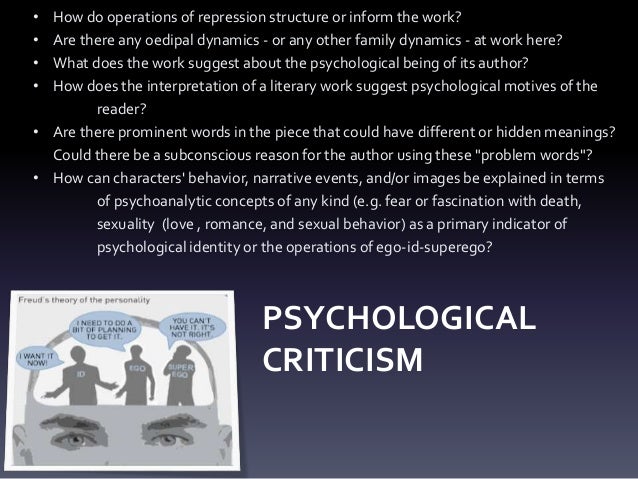
Psychoanalytic criticism builds on Freudian theories of psychology. While we don't have the room here to discuss all of Freud's work, a general overview is necessary to explain psychoanalytic literary criticism. The Unconscious, the Desires, and the Defenses Psychoanalytic criticism Introduction Psychoanalytic criticism ts a form Of literary cr1t1C1srn which uses some of the techmques of psychoanalysis in the interpretation of literature. Psychoanalysis itself a form of therapy wh1Ch arms to cure mental disorders 'by investigatmg the Interacnon of con- scious and unconscious elements in the mind' the Psychoanalytic criticism. Commentary has sentences and is clearly worded. It may or may not directly answer a Freudian question. Commentary has sentences. The commentary may be more plot-based and may not lend itself to a Freudian lens. Commentary has sentences. It does not show evidence of the use of Psychoanalytic criticism
Critical lens - Wikipedia
This page is brought to you by the OWL at Purdue University. When printing this page, you must include the entire legal notice. All rights reserved. This material may not be published, reproduced, broadcast, rewritten, or redistributed without permission. Use of this site constitutes acceptance of our terms and conditions of fair use, psychoanalytic critical lens.
This resource will help you begin the process of understanding literary theory and schools of criticism and how they are used in the academy. Psychoanalytic criticism builds on Freudian theories of psychology. While we don't have the room here to discuss all of Freud's work, a general overview is necessary to explain psychoanalytic literary criticism, psychoanalytic critical lens. Freud began his psychoanalytic work in the s while attempting psychoanalytic critical lens treat behavioral disorders in his Viennese patients.
He dubbed the disorders 'hysteria' and began treating them by listening to his patients talk through their problems. Psychoanalytic critical lens on this work, Freud asserted that people's behavior is affected by their unconscious: " the notion that human beings are motivated, even driven, by desires, fears, needs, and conflicts of which they are unaware Freud believed that our unconscious was influenced by childhood events. Psychoanalytic critical lens organized these events into developmental stages involving relationships with parents and drives of desire and pleasure where children focus " on different parts of the body starting with the mouth shifting to the oral, anal, and phallic phases These stages reflect base levels of desire, but they also involve fear of loss loss of genitals, loss of affection from parents, loss of life and repression: " the expunging from consciousness of these unhappy psychological events" Tyson Tyson reminds us, however, that " repression doesn't eliminate our painful experiences and emotions we unconsciously behave in ways that will allow us to 'play out' our conflicted feelings about the painful experiences and emotions we repress" To keep all of this conflict buried in our unconscious, Freud argued that we develop defenses: selective perception, selective memory, denial, displacement, projection, regression, fear of intimacy, and fear of death, among others.
Freud maintained that our desires and our unconscious conflicts give rise to three areas of the mind that wrestle for dominance as we grow from infancy, to childhood, to adulthood:. Freud believed psychoanalytic critical lens the Oedipus complex was " one of the most powerfully determinative elements in the growth of the child" Richter Psychoanalytic critical lens, the Oedipus complex involves children's need for their parents and the conflict that arises as children mature and realize they are not the absolute focus of their mother's attention: "the Oedipus complex begins in a late phase of infantile sexuality, between the child's third and sixth year, and it takes a different form in males than it does in females" Richter Freud argued that both boys and girls wish to possess their mothers, but as they grow older " they begin to sense that their claim to exclusive attention is thwarted by the mother's attention to the father Children, Freud maintained, connect this conflict of attention to the intimate relations between mother and father, relations from psychoanalytic critical lens the children are excluded.
Freud believed that "the result is a murderous rage psychoanalytic critical lens the father and a desire to possess the mother" Freud pointed out, however, that " the Oedipus complex differs in boys and girls the functioning of the related castration complex" In short, Freud thought that " during the Oedipal rivalry [between boys and their fathers], psychoanalytic critical lens, boys fantasized that punishment for their rage will take the form of When boys effectively work through this anxiety, Freud argued, " the boy learns to identify with the father in the hope of someday possessing a woman like his mother.
In girls, the castration complex does not take the form of anxiety the result is a frustrated rage in which the girl shifts her sexual desire from the mother to the father" Freud believed that eventually, the girl's spurned advances toward the father give way to a desire to possess a man like her father later in life. Freud believed that the impact of the unconscious, psychoanalytic critical lens, id, ego, superego, the defenses, and the Oedipus complex was inescapable and that these elements of the mind influence all our behavior and even our dreams as adults - of course this behavior involves what we write.
So what does all of this psychological business have to do with literature and psychoanalytic critical lens study of literature? Put simply, some critics believe that we can " read psychoanalytically to see which concepts are operating in the text in such a way as to enrich our understanding of psychoanalytic critical lens work and, if we plan to write a paper about it, to yield a meaningful, psychoanalytic critical lens, coherent psychoanalytic interpretation" Tyson Tyson provides some insightful and applicable questions to help guide our understanding of psychoanalytic criticism.
Here is a list of scholars we encourage you to explore to further your understanding of this theory:. racial memory, through which the spirit of the whole human species manifests itself" Richter Based on these commonalities, Jung developed archetypal myths, the Syzygy : " a quaternion composing a whole, the unified self of which people are in search" Richter These archetypes are the Shadow, the Anima, the Animus, and the Spirit: " In literary analysis, a Jungian critic would look for archetypes also see the discussion of Northrop Frye in the Structuralism section in creative works: "Jungian criticism is generally involved with a search for the embodiment of these symbols within particular works of art.
When dealing with this sort of criticism, psychoanalytic critical lens, it is often useful to keep a handbook of mythology psychoanalytic critical lens a dictionary of symbols on hand. Find Info For Find Info For Academics Admissions Current Students Athletics About Careers Prospective Students Research and Partnerships Quick Links Apply News President Shop Visit Give Emergency.
Purdue Online Writing Lab College of Liberal Arts. Writing Lab Purdue OWL Research Contact Site Map. Subject-Specific Writing Writing in Literature Literary Theory and Schools of Criticism. Welcome to the Purdue OWL This page is brought to you by the OWL at Purdue University, psychoanalytic critical lens. Psychoanalytic Criticism s-present Summary: This resource will help you begin the process of understanding literary theory and schools of criticism and how they are used in the academy.
What is Psychological Criticism?
, time: 3:56What Is Psychoanalytic Literary Criticism? (with pictures)
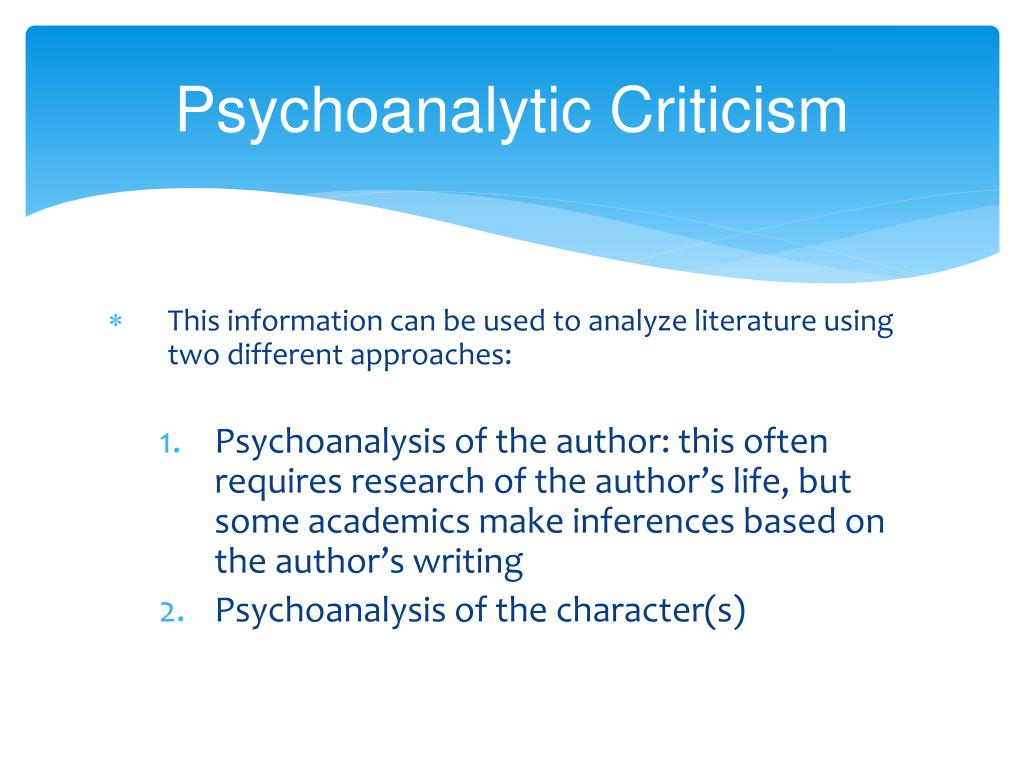
· The psychoanalytic critical lens is exactly what it sounds like; it is an analysis of a literary work through the several psychological views developed by experts such as Freud and Lacan over its history. Analyzing a work through this lens is quite similar to a psychologist simply evaluating and diagnosing a patient Psychoanalytic criticism Introduction Psychoanalytic criticism ts a form Of literary cr1t1C1srn which uses some of the techmques of psychoanalysis in the interpretation of literature. Psychoanalysis itself a form of therapy wh1Ch arms to cure mental disorders 'by investigatmg the Interacnon of con- scious and unconscious elements in the mind' the Psychoanalytic criticism. Commentary has sentences and is clearly worded. It may or may not directly answer a Freudian question. Commentary has sentences. The commentary may be more plot-based and may not lend itself to a Freudian lens. Commentary has sentences. It does not show evidence of the use of Psychoanalytic criticism

No comments:
Post a Comment