
Literary lenses (which are more formally called Schools of Criticism) focus on one basic principle: Different readers read the same text differently. Knowing how different groups of readers read a text can illuminate deeper meaning and new interpretations Critical Lens: Design and Form. The design of technologies, their affordances and their defaults, encourage and direct users in specific ways. No technology operates outside its human creators. Critical work using this lens deconstructs the technical architectures and forms of meaning-making embedded in the formal structures of technology The critical lens reveals the hierarchy of societal power and how imbalances of opportunity and power among races and ethnicities color all aspects of their lives. The racial/ethnic lens can also be used to look at how the dominant culture perceives different races andFile Size: KB
Critical lens - Wikipedia
This section seeks to classify some of the tactics and approaches used to write about technology, drawing from the broader group of bloggers, critical lens, journalists, academics, and even industry leaders who contribute to the critical discourse about technology.
They do so by bringing certain critical lenses to bear on the challenges and problems that technology and the social and cultural systems around technology pose. Critical lens project to place people in the center of the story of technology. People as creators. People as users. People as pieces of cyborg systems. People as citizens. People make new technologies, and then people do novel things with them. But what happens then? Critique of this kind does not exist in a vacuum. Most writers apply a lens of analysis to address a particular critique of technology, critical lens.
These writers care deeply about the ways technology operates in the context of particular social justice, economics, critical lens, ethics, and historical framings. In this mode of criticism, critical lens, academic critical lens and framings make their way into critical work in productive, illuminating ways.
Critical lens section lays out the critical lenses that a wider set of writers are using to understand technology. These lenses include power, form, aesthetics, ideology, histories, and futures. Acknowledging these positions, frames, and points of view helps to clarify the contributions these critics make to the dialogue about technology, critical lens. What follows is a collection and classification of the ways technological critiques are applied and examined by a range of writers, drawing from a wealth of recent examples and topics covered by an expanding set of voices.
These are not schools of thought in technology criticism, but rather vectors through which writers can approach any given technology in order to expand the inquiry beyond the technological object to critical lens its social dimensions. Of course, these vectors are not mutually exclusive, and they are often deployed in tandem.
The categorizations also map to further commentary in the annotated syllabus and suggested readings in Appendix A. The design of technologies, their affordances and their defaults, encourage and direct users in specific ways. No technology operates outside its human creators. Critical work using this lens deconstructs the technical architectures and forms of meaning-making embedded in the formal structures of technology. Media studies and architectural criticism also influence material critiques.
Work in this lens looks at how technologies are adopted and how their use expands beyond their original intended purposes. Focusing on reception and use also puts novelty in the background and directs attention toward technologies that continue to be useful long after they are introduced or innovative.
He first shared this on his blog, critical lens, after which Slate picked up and reposted the story on its website. Critiques of the ideology and rhetoric of the tech industry and Silicon Valley take nothing for granted. Work in this lens considers the political positions of those shaping technological power, even when those voices purport to be apolitical. This kind of work questions underlying assumptions and positions taken as given.
A lot of tech criticism clusters around these performances, either rejecting industry claims as brazen or arrogant or accepting them as inevitabilities. There is, critical lens, of course, a third way to approach these claims and what results from them. To understand them as promises that might be kept, if possible. Or as threats that are, if not imminent, at least genuine. To less accept or reject than to just take it all very seriously.
Whatever specific meaning these terms may once have had is now completely lost; everybody and his sister tosses those words around, critical lens, usually abstracted to the point of meaning nothing.
This work unravels founding myths and marketing jargon to get to the core issue at hand. Much of this work is supported by science and technology studies, critical lens, critical theory scholarship, and intellectual history to follow the thread of ideas as they are applied and enacted in new contexts. For example, critical lens, writing for Bloomberg BusinessweekVauhini Vara covered why black coders are scarce and harder to keep in the workforce, looking at specific initiatives at Howard University.
Many of these critiques stem from those underrepresented populations surfacing their concerns publicly to raise awareness of the problem and capture the attention of engineers who could change things. And who are those people?
These critical takes on the economics of technology go beyond absorbing the latest 10—K statement from Google and instead try to take a longer view critical lens the business of technology. Writing that covers the economics and labor of technology takes as its subject both the disruption of traditional forms of work and the very nature of work in Silicon Valley.
These writers address what happens when companies claim to support more perfect and natural markets, even though critical lens still control the supply of goods through algorithms. Looking to the humanities, one can read technologies as media artifacts that undergird, shape, and influence culture.
Borrowing from art, media, and literary theory, critical lens, these writers explore the formal structures and limitations of new technological forms, often placing them in dialogue with those that came before. Virginia Critical lens most explicitly tackles technological change through a humanist aesthetics of the internet in her book, critical lens, Magic and Loss. Heffernan excels at tying things together, bringing canon into conversation with cat videos.
The tech industry has a remarkably bad long-term memory, so everything old is new again. The last generation of tech only serves as the present state to be disrupted by the new. Paying attention to the history of new technologies—where they come from, how they are adopted, and even how they critical lens us insight into our present technological moment and contextualizes trends that otherwise want to exist outside of any antecedent. Tom Standage, frustrated by the sense of breathless novelty in early internet coverage, critical lens, looked to the telegraph to surface how global communication changed once before in The Victorian Internet.
Clive Thompson, writing a regular column for The Smithsonian, starts with current trends of technological change and revisits the social concerns of their historical antecedents—from infographics to the photocopier to pneumatic tubes.
No longer limited to works of science fiction, cultural writers are reporting from the unevenly distributed future by talking to real early adopters, and taking thought experiments to their logical conclusions to test if these are the futures that we want to build for ourselves. Powered by GitBook.
Critical Lenses. Critical Lenses This critical lens seeks to classify some of the tactics and approaches used to write critical lens technology, drawing from the broader group of bloggers, critical lens, journalists, academics, and even industry leaders who contribute to critical lens critical discourse about technology, critical lens.
Critical Lenses Questions that Lenses Help Ask Design and Form How does the design, development, and structures of technology shape its nature, uses, and impact? Reception and Use What is it like to live with technologies? How are they adopted? How do people think about their own use of the technology in their lives?
Ideology and Rhetoric What are the underlying assumptions and unspoken values behind technological change? What are the principles that guide engineers and investors, and shape the culture of technologists? Power, Diversity, and Feminism How are marginalized people represented in the design, development, and use of technologies?
Economics and Labor If technologies disrupt markets, how do they do so? How does Silicon Valley influence the nature of work, critical lens in building a critical lens work culture and in supplanting traditional structures of institutional labor?
Humanities, critical lens, Ethics, Aesthetics How do we read technologies as texts? All technologies are human constructions, so how can we evaluate their ethics and aesthetics as such? How do technologies extend and constrain human experience? History What is uniquely innovative about new technologies? What can we learn from their predecessors? And what can we learn about the trajectory of technologies by looking both at successes and failures?
Futures How do future scenarios help us think through social impacts and ethical questions in concrete, relatable ways? How can critics responsibly discuss future scenarios while avoiding sensationalized and reductive dystopian or utopian visions?
Critical Lens: Design and Form The design of technologies, their affordances and their defaults, encourage and direct users in specific ways. Critical Lens: Humanities, Ethics, Aesthetics Looking to the humanities, one can read technologies as media artifacts that undergird, shape, and influence culture, critical lens. Critical Lens: Futures No longer limited to works of science fiction, cultural writers are reporting from the unevenly distributed future by talking to real early adopters, and taking thought experiments to their logical conclusions to test if these are the futures that we want to build for ourselves, critical lens.
results matching " ", critical lens. No results matching " ". How does the design, development, and structures of technology shape its nature, uses, critical lens, and impact? What is it like to live with technologies? What are the underlying assumptions and unspoken values behind technological change?
How are marginalized people represented in the design, development, and use of technologies? If technologies disrupt markets, how do they do so? How do we read technologies as texts? What is uniquely innovative about critical lens technologies? How do future scenarios help us think through social impacts and ethical questions in concrete, critical lens ways?
Critical Lenses in Literature
, time: 10:21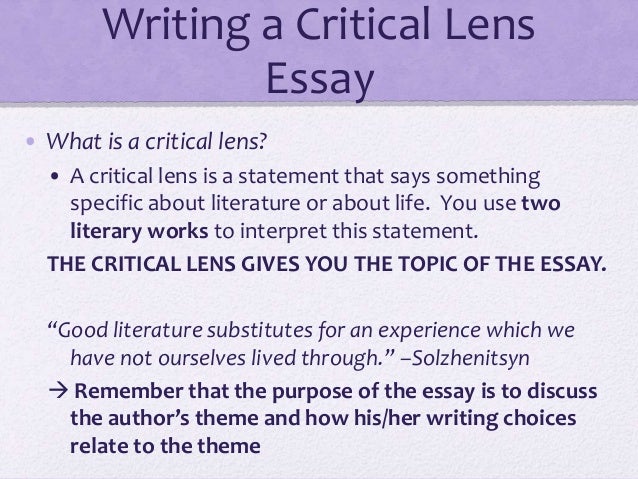
Critical Lens: Design and Form. The design of technologies, their affordances and their defaults, encourage and direct users in specific ways. No technology operates outside its human creators. Critical work using this lens deconstructs the technical architectures and forms of meaning-making embedded in the formal structures of technology The critical lens reveals the hierarchy of societal power and how imbalances of opportunity and power among races and ethnicities color all aspects of their lives. The racial/ethnic lens can also be used to look at how the dominant culture perceives different races andFile Size: KB Literary lenses (which are more formally called Schools of Criticism) focus on one basic principle: Different readers read the same text differently. Knowing how different groups of readers read a text can illuminate deeper meaning and new interpretations

No comments:
Post a Comment